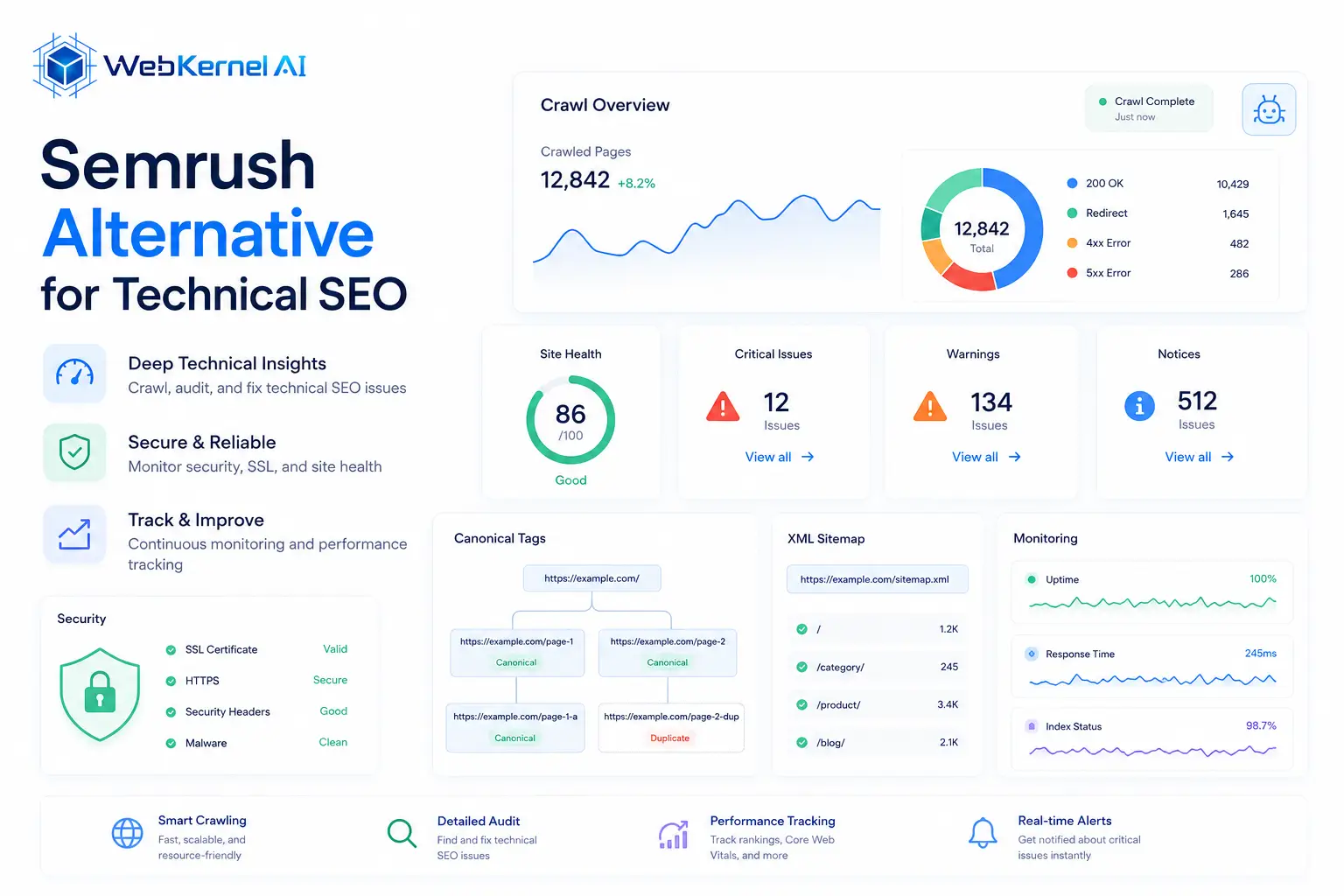
Deep Technical Crawl Context vs. High-Level Marketing Checklists
Standard technical SEO checklists generated by all-in-one marketing suites help check simple optimization boxes but rarely expose the underlying architectural issues bailing indexation runs. WebKernelAI approaches website diagnostics as a software debugging and code security validation process:
1. Template Audits vs. Specialized Cloud Crawling
Generalist suites crawl pages using linear algorithms designed to flag obvious missing attributes (H1s, meta tags). WebKernelAI deploys high-performance recursive pipelines that map exact physical structures, isolating staging regressions, TTFB delays, and circular redirect paths.
2. Flattened Spreadsheet lists vs. Redirect Loop Trees
Dealing with complex htaccess configurations or deep sitemap redirection cascades inside tabular sheets makes identifying root-cause nodes nearly impossible. WebKernelAI parses circular redirect loops visually, showing developers exactly where redirects bleed crawl budgets.
3. Standard XML Scrapes vs. Overlap Sitemap Logic
Rather than just verifying if an XML sitemap is present, WebKernelAI maps sitemap references against physical crawl outcomes. We isolate sitemap-index mismatch parameters, locate high-value orphan directories, and check robots.txt exclusions in real-time.
4. JavaScript SEO & hydrated DOM Comparisons
Dynamic Client-Side Rendering (CSR) framework issues are a frequent cause of indexing drop-offs. WebKernelAI executes headless dynamic analysis, comparing pre-hydrated SSR layouts against the final client DOM to highlight bails and script execution blocks.