
WebKernelAI vs Ahrefs

A technical evaluation for search engineers separating backlink analytics from code-level crawling diagnostics.

  • Home
  • WebKernelAI vs Ahrefs
Technical SEO Companion

WebKernelAI vs Ahrefs

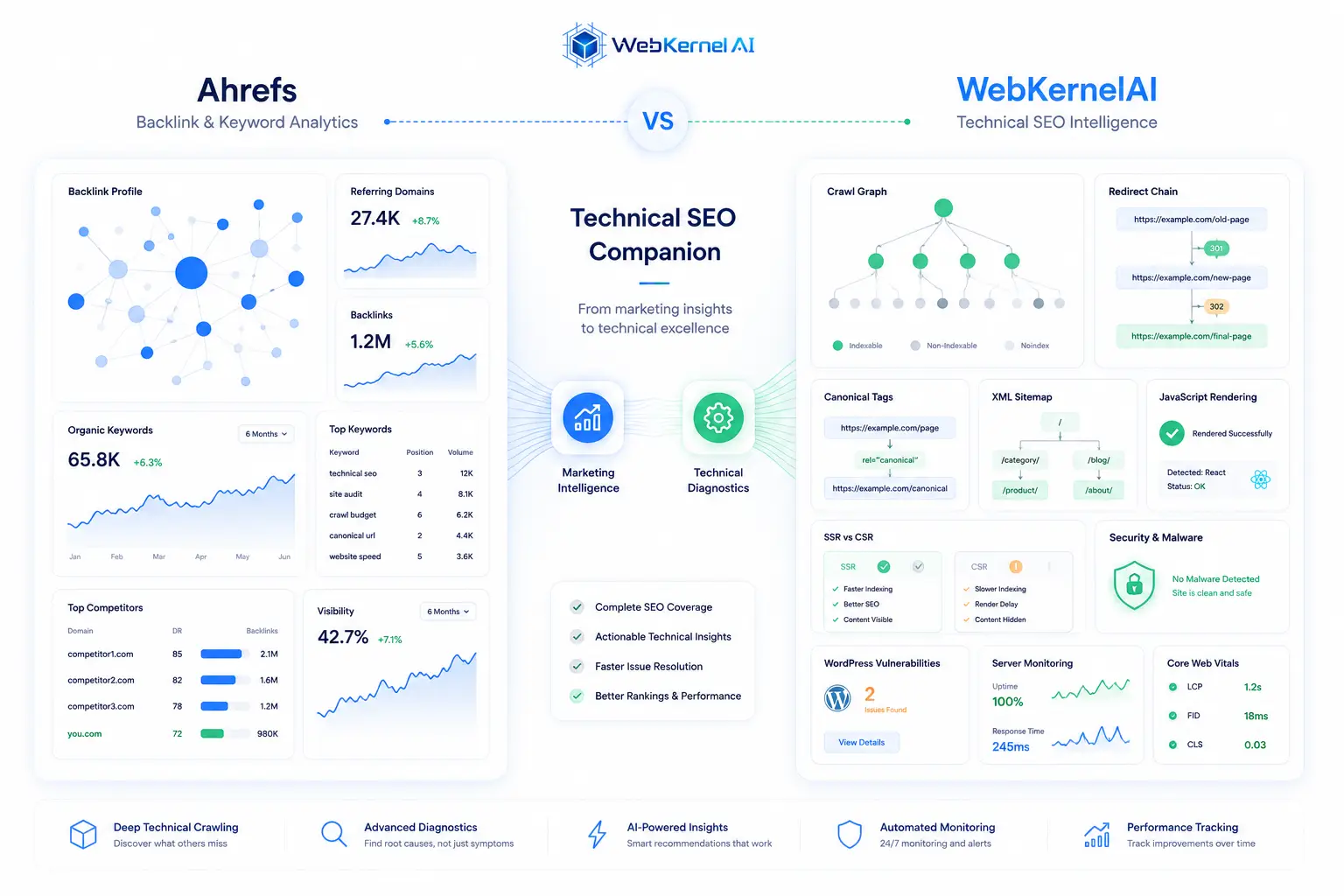
Let's establish honest positioning: WebKernelAI does not replace Ahrefs. If you need to monitor domain-level referring links, track backlink intersection across competitors, or run keyword research for organic landing pages, Ahrefs remains the undisputed market leader.

WebKernelAI acts as a specialized **technical SEO and security platform**. We focus exclusively on the areas that off-page link analysis tools treat as secondary modules: recursive crawl loop maps, dynamic SSR vs. CSR DOM rendering comparisons, WordPress vulnerability audits, injected malware checks, and automated hourly alert systems.

webkernelai.com/ahrefsWK · AICRAWL SAFEsitemap.xml/guides/pricingMONITORINGACTIVE

WebKernelAI vs Ahrefs Feature Matrix

A granular, practitioner comparison separating off-page backlink intelligence from deep on-page crawl diagnostics.

FeatureAhrefsWebKernelAI
Backlink Index & Referring Domain Logs
Native Full (World Class Index)
None (Pure structural focus)
Technical SEO Audits & Response Diagnostics
Standard / Template-based
Native Full (Distributed crawl)
Interactive Redirect Loop Isolation
Standard / Tabular exports
Native Full (Recursive tree maps)
WordPress Code Vulnerability CVSS Checking
None
Native Full (Dynamic plugin matches)
Injected Malware & Script Cloaking Scans
None
Native Full (Malicious redirects)
JavaScript SEO Hydration comparison
Standard / Basic headless
Native Full (SSR vs CSR visual delta)
Sitemap Overlaps & Crawl Budget Waste
Standard / Simple list logs
Native Full (Orphan & path checks)
Automated Cron Crawling & Alerting
Standard / Weekly schedules
Native Full (Hourly & alert hooks)
AI Narrative Remediation Summaries
None
Native Full (Plain language digests)
LLMS.txt Optimization Tools
None
Native Full (AI agent indexing files)

Deep Technical Crawl Context vs. High-Level Marketing Checklists

Standard technical SEO checklists generated by all-in-one marketing suites help check simple optimization boxes but rarely expose the underlying architectural issues bailing indexation runs. WebKernelAI approaches website diagnostics as a software debugging and code security validation process:

1. Template Audits vs. Specialized Cloud Crawling

Generalist suites crawl pages using linear algorithms designed to flag obvious missing attributes (H1s, meta tags). WebKernelAI deploys high-performance recursive pipelines that map exact physical structures, isolating staging regressions, TTFB delays, and circular redirect paths.

2. Flattened Spreadsheet lists vs. Redirect Loop Trees

Dealing with complex htaccess configurations or deep sitemap redirection cascades inside tabular sheets makes identifying root-cause nodes nearly impossible. WebKernelAI parses circular redirect loops visually, showing developers exactly where redirects bleed crawl budgets.

3. Standard XML Scrapes vs. Overlap Sitemap Logic

Rather than just verifying if an XML sitemap is present, WebKernelAI maps sitemap references against physical crawl outcomes. We isolate sitemap-index mismatch parameters, locate high-value orphan directories, and check robots.txt exclusions in real-time.

4. JavaScript SEO & hydrated DOM Comparisons

Dynamic Client-Side Rendering (CSR) framework issues are a frequent cause of indexing drop-offs. WebKernelAI executes headless dynamic analysis, comparing pre-hydrated SSR layouts against the final client DOM to highlight bails and script execution blocks.
Use Ahrefs if...

Off-Page & Competitor Analytics

  • World-class backlink indicesYou need to track referring domains, isolate link intersection graphs across competitors, and research historical domain authority records.
  • Global keyword researchYou are designing long-tail keyword maps, analyzing organic search volume across countries, and tracking historical SERP features.
  • Competitor content strategiesYou want unified dashboards that show competitor high-traffic organic nodes and map link acquisition velocities.

Use WebKernelAI if...

SaaS Auditing & Code Vulnerabilities

  • Continuous automated monitoringYou want zero local installs and prefer cloud-native automated crawls that identify codebase anomalies and staging regressions.
  • WordPress CVE vulnerabilitiesYou manage extensive WordPress fleets and require plugin and theme hash checking against live CVE threat databases.
  • JavaScript hydration comparisonsYou use Next.js, React, or dynamic frameworks and want side-by-side SSR vs. CSR delta audits to protect indexing paths.
  • Guided technical workflowsYou need plain-language summaries that translate database, routing, or header issues directly into engineering directives.
  • Malware script defenseYou need checks for cloaked dynamic redirects, spam link injections, and active malware patterns affecting domain reputation.

Pairing High-Volume Backlink Strategy with Developer Safeguards

Modern search engine optimization spans both marketing planning and technical execution. Growth teams and massive agency networks cannot thrive on backlink lists alone if staging build anomalies, dynamic rendering conflicts, or server-side redirect chains block crawl bots from parsing page layouts.

Operating both platforms side-by-side creates the ultimate SEO safeguard. While Ahrefs coordinates off-page link graphs and monitors competitor keywords, WebKernelAI runs in the background, matching plugin hashes with active CVE vulnerability registries and alerting backend developers of circular redirect loops instantly via Webhook.

Specialist Practice: Use Ahrefs' backlink logs to plan link outreach targets. Once deployed, set WebKernelAI's crawlers to verify sitemaps, headers, and code safety automatically.

WebKernelAI Technical Audit Interface Showcase

Fig 4.1 — Cloud Audit Console & Security Pipeline inside WebKernelAI

Continuous Technical SEO Safeguards: Where WebKernelAI Fits Beside General Suites

Why digital engineering departments, WordPress administrators, and developers deploy cloud-level diagnostics.

Crawl-Waste Throttling

Throttling crawler rates dynamically is essential to preserve host performance. Rather than overwhelming server resources during large runs, WebKernelAI's distributed queuing adjust requests automatically to balance crawl speed against origin capability.

Dynamic SSR vs CSR

Comparing server-rendered structures to dynamic DOM outcomes highlights client-side framework failures (Next.js bails, missing dynamic links, or rendering delays). WebKernelAI maps these structural discrepancies side-by-side instantly.

Interactive Loop Maps

Circular redirect chains bleed crawl equity and block crawling pipelines. WebKernelAI translates flat redirect records into visual parent-child nodes, letting developers trace circular redirect paths and correct them immediately.

WordPress CVE Auditing

WordPress cores, plugins, and active themes represent high-priority vulnerability points. WebKernelAI matches scanned plugin configurations with dynamic CVE security databases, providing code safety alongside standard sitemap analysis.

Malware Injection Checks

Cyber attacks regularly target organic search traffic via cloaked malicious redirects. WebKernelAI crawls target assets using standard browser profiles to identify dynamic redirect spam and prevent swift search engine blacklisting.

Continuous Alert Integration

Manual scans are vulnerable to human delays. WebKernelAI features real-time notifications (Slack, Discord, and Email Webhooks) that trigger immediately when sitemap changes or structural anomalies occur, keeping developers informed.

Run Specialized Technical Checks

Deploy cloud diagnostics instantly without software installation. Validate sitemaps and redirect strings in real-time.

Frequently Asked Questions

No. Ahrefs is the world's most powerful platform for off-page search intelligence, boasting the largest independent backlink index, detailed referring domain logs, and historical keyword difficulty logs. WebKernelAI is a specialized, engineering-grade platform designed for technical SEO auditing, sitemap parsing, javascript rendering checks, and code-level security scanning. Most mature enterprise teams use both together, relying on Ahrefs for link building and WebKernelAI for technical health and code security.

Yes. WebKernelAI features a high-performance recursive crawler that parses thousands of pages in minutes. It executes standard and JavaScript-heavy audits, rendering Client-Side Rendered (CSR) pages to isolate indexing bails, shadow DOM rendering lags, script bloat, and core web vitals regressions. It also detects structural issues like circular redirect loops, broken canonical mapping, and sitemap exclusions.

Yes. Built on scalable serverless crawlers and backed by Redis job pipelines, WebKernelAI easily crawls and audits websites with hundreds of thousands of pages. It features intelligent crawl budget protection, throttling crawl rates automatically to protect origin servers while isolating high-priority architecture problems and duplicate parameter pathways that trigger crawl waste.

Yes. Unique among technical SEO platforms, WebKernelAI contains a security-aware auditing engine. It scans target websites for core WordPress vulnerabilities, active plugin bugs, and malicious theme scripts by matching core profiles against active CVE directories. It also crawls for background spam injection, malware-driven silent redirects, and missing security headers.

Using both tools allows teams to separate off-page backlink and keyword strategy from on-page technical diagnostics. Ahrefs provides the 'what' (domain authority, keyword traffic, and link profiles), while WebKernelAI provides the 'why' and 'how' (broken server-side redirects, JavaScript indexing gaps, silent malware-cloaked redirects, and structural SEO regressions). Pairing them provides a highly robust, secure web defense.

Related Guides

Continue with these guides to strengthen your technical SEO workflow.