Semrush Alternative — Technical SEO

An honest comparison for search practitioners separating keyword marketing from engineering-grade crawl diagnostics.

  • Home
  • Semrush Alternative — Technical SEO
Specialist Technical Companion

The Specialist Technical SEO Alternative to Semrush

Let's be completely honest: WebKernelAI does not replace Semrush. We don't maintain a 25-billion keyword index, trace competitive PPC ad spend, or compile daily rank-tracking dashboards. Semrush remains a powerhouse for macro marketing visibility.

Instead, WebKernelAI acts as a surgical **technical SEO alternative** and **crawl analysis tool**. We are built specifically for developer-facing website audits, circular redirect loop isolation, sitemap crawling intelligence, WordPress vulnerability identification, and continuous, automated security diagnostics.

webkernelai.com/auditWK · AICRAWL SAFEsitemap.xml/guides/pricingMONITORINGACTIVE

Direct Capability Comparison: Semrush vs. WebKernelAI

A granular evaluation of where suite-level visibility ends and developer-grade crawling diagnostics begin.

FeatureSemrushWebKernelAI
Keyword Research & Difficulty Tracking
Native Full (25B+ Term Index)
None (Pure structural focus)
Technical SEO Audits
Standard / Template-based
Native Full (Recursive pipelines)
Crawl Analysis & Loop Isolation
Standard / URL list lists
Native Full (Tree graphs & loops)
Malware & Code Security Detection
None
Native Full (Malicious script checks)
WordPress Security Insights & CVE Matching
None
Native Full (Theme/plugin match)
JavaScript Rendering Diagnostics
Standard / Basic headless
Native Full (SSR vs CSR side-by-side)
Sitemap Intelligence & Coverage Validation
Standard / List errors
Native Full (Overlap & budget waste)
Canonical Analysis & Chain Mapping
Standard / Flags missing tags
Native Full (Circular chain audits)
Continuous Large-scale Monitoring
Standard / Weekly schedules
Native Full (Hourly & alert hooks)
AI Audit Narratives & Engineering Digests
None
Native Full (Neural executive reports)

Feature-by-Feature Deep Dive: Why implementation matters

Standard site audit reports compiled by generalized enterprise dashboards are designed to give high-level progress indicators to non-technical stakeholders. They frequently fail to isolate structural defects because they scrape page arrays in simple batches. WebKernelAI treats website crawling as a software debugging process:

1. Standard Crawling vs. Recursive Diagnostics

General marketing suites crawl pages linearly and flag broken assets. WebKernelAI runs recursive node parsing that charts the physical architecture of the site, letting engineers pinpoint orphaned directories, deep routing paths, and missing server headers before bailing search engine indexing runs.

2. Flattened Spreadsheets vs. Redirect Loop Tree Maps

Semrush lists redirect issues in a tabular format. When dealing with complex htaccess configurations or dynamic routing chains, simple spreadsheets cannot show the parent-child node connections. WebKernelAI isolates circular loops, multi-hop redirect chains, and PageRank leaks with visual vector mapping.

3. Standard XML Scans vs. Sitemap Intelligence

Rather than just checking if a sitemap is present, WebKernelAI performs sitemap vs. actual crawl overlap logic. We identify pages in the sitemap that return non-200 codes, detect URLs that are blocked by robots.txt but listed in the XML index, and locate high-value orphan pages completely missing from the directory mapping.

4. JavaScript SEO & Source vs. Client DOM Audits

Heavy Client-Side Rendering (CSR) often prevents search engine bots from executing scripts. WebKernelAI compares the pre-rendered SSR HTML with the dynamic client DOM after the hydration cycle, flagging missing links, hidden meta tags, and script errors bailing indexation.
Use Semrush if...

Omnichannel Marketing focus

  • Keyword tracking priorityYou need to track daily position changes for thousand-word keyword buckets across multiple locations and coordinate search volume benchmarks.
  • PPC and marketing reportingYou are planning search engine marketing campaigns, tracking competitor paid ad copies, and budgeting omnichannel PPC bids.
  • Share-of-voice monitoringYou need unified executives dashboards that aggregate organic visibility, content scores, and PR backlinks for corporate marketing reviews.

Use WebKernelAI if...

Engineering-Grade Crawl Diagnostics

  • Technical SEO investigationsYou are coordinating a major site migration, debugging circular redirect chains, or analyzing Javascript SEO rendering mismatches.
  • Website architecture debuggingYou need deep recursive crawl tree mappings to isolate duplicate paths, crawl-waste parameters, and sitemap-index mismatches.
  • WordPress-heavy fleetsYou manage WordPress core assets and require active plugin, theme, and code vulnerability checks matched against dynamic CVE listings.
  • Crawl anomaly monitoringYou need automated, hourly sitemap and code-change scans that alert engineers of server regressions instantly via webhooks.
  • Security-aware SEO workflowsYou want protection against injected malware redirects, cloaked malicious links, and missing security headers like Content Security Policy.

Pairing High-Fidelity Crawling with Global Marketing Analytics

Modern search engine optimization is no longer just a marketing discipline—it is an engineering reality. Large SaaS setups and enterprise WordPress networks cannot survive on keyword lists alone if server bails, duplicate index bloat, or background scripts prevent crawl bots from parsing page architectures.

Rather than treating these tools as competing solutions, mature agencies and growth teams operate them side-by-side. Our developer-grade console maps exact node connections, detects circular redirects, and matches plugin hashes with active CVE vulnerability databases. It bridges the gap between digital marketing planners and backend web developers.

Did you know? Over 84% of critical indexation regressions occur due to staging deployments bailing canonical tags or circular redirect chains. WebKernelAI catches these errors before search bot crawls dilute your search visibility.

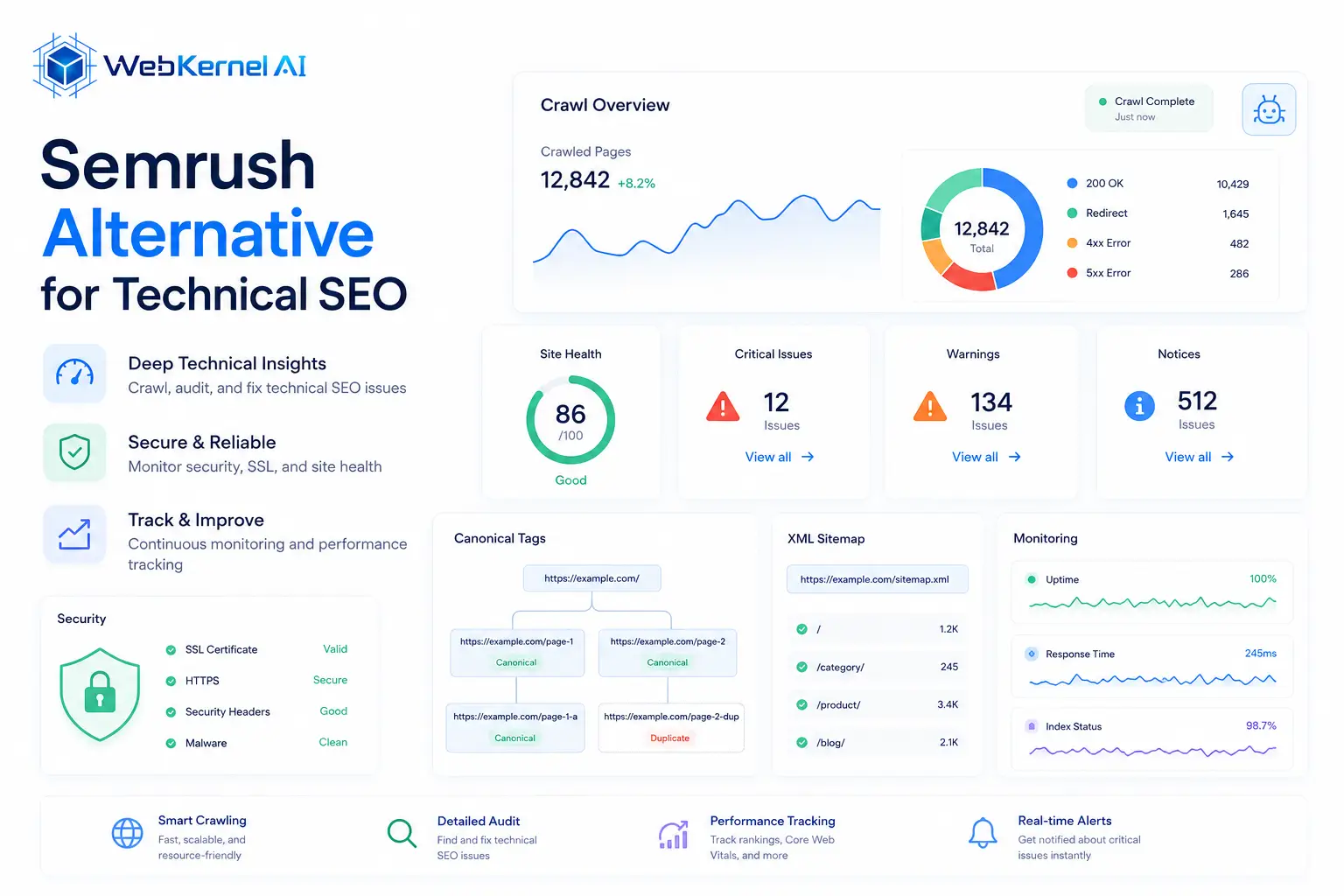
WebKernelAI Technical Audit Interface Showcase

Fig 1.1 — WebKernelAI Audit Pipeline & Diagnostic Dashboard

Why Engineering Teams Run WebKernelAI Beside Semrush

SEO suites are built for organic marketers; WebKernelAI is built for technical practitioners, DevOps, and web engineering departments.

Crawl Budget Anomalies

Search engines allocate a finite time window (crawl budget) to index a website. Dynamic index bloat, unresolved parameters, and broken internal assets force bots to leave before indexing critical revenue-generating pages. WebKernelAI isolates crawl-waste paths to maximize search engine indexing runs.

Redirect Chain Analysis

Multi-hop redirect chains dilute link equity (PageRank) and add critical milliseconds to Time-to-First-Byte (TTFB) times. Since search crawlers refuse to follow chains longer than five hops, dynamic redirects completely block path discovery. WebKernelAI recursively checks and traces redirect paths.

Canonical Conflicts

Conflicting canonical signals confuse indexation engines, splitting page authority across duplicate paths. WebKernelAI parses self-referential canonical tags, cross-domain parameter conflicts, and circular canonical chains, ensuring clean authority signals reach crawling bots.

JS Vulnerability Scans

Outdated npm packages, inline libraries, and dependencies act as active entry points for cyber attacks. Because search engines penalize sites with vulnerable dynamic assets, ensuring script-level security is critical. WebKernelAI matches live dynamic elements with CVE indexes in real-time.

Malware Auditing

Hackers regularly deploy silent redirects (malicious cloaking) that target organic visitors but display normal layouts to site owners. When bots identify these scripts, search engines blacklist the domain immediately. WebKernelAI crawls the website using standard crawler heuristics to spot hidden redirects and spam.

Engineering Diagnostics

Most SEO platforms offer generic suggestions. WebKernelAI provides actionable code-level fixes, showing web developers specific header updates (like Content Security Policy or X-Frame-Options), CSS bails, and theme modifications required to resolve issues.

Run Specialized Technical Checks

Deploy developer-grade diagnostics instantly. No installation required. Test single URLs or sitemap paths side-by-side.

Frequently Asked Questions

No. Semrush is an all-in-one search marketing platform designed for keyword research, PPC planning, competitive intelligence, and daily position tracking. WebKernelAI is a specialized, engineering-grade platform designed for technical SEO auditing, sitemap parsing, javascript rendering checks, and code-level security scanning. Most mature enterprise teams use both together, relying on Semrush for keyword strategy and WebKernelAI for technical health and code security.

Yes. WebKernelAI features a high-performance recursive crawler that parses thousands of pages in minutes. It executes standard and JavaScript-heavy audits, rendering Client-Side Rendered (CSR) pages to isolate indexing bails, shadow DOM rendering lags, script bloat, and core web vitals regressions. It also detects structural issues like circular redirect loops, broken canonical mapping, and sitemap exclusions.

Yes. Built on scalable serverless crawlers and backed by Redis job pipelines, WebKernelAI easily crawls and audits websites with hundreds of thousands of pages. It features intelligent crawl budget protection, throttling crawl rates automatically to protect origin servers while isolating high-priority architecture problems and duplicate parameter pathways that trigger crawl waste.

Yes. Unique among technical SEO platforms, WebKernelAI contains a security-aware auditing engine. It scans target websites for core WordPress vulnerabilities, active plugin bugs, and malicious theme scripts by matching core profiles against active CVE directories. It also crawls for background spam injection, malware-driven silent redirects, and missing security headers.

Using both tools allows teams to separate marketing analytics from engineering diagnostics. Semrush provides the 'what' (ranking fluctuations, competitive keyword loss, and PPC visibility), while WebKernelAI provides the 'why' and 'how' (broken server-side redirects, JavaScript indexing gaps, silent malware-cloaked redirects, and structural SEO regressions). Pairing them provides a highly robust, secure web defense.

Related Guides

Continue with these guides to strengthen your technical SEO workflow.